.png)

University of Washington Housing: Off-Campus Living Guide
- Owen Conrad
- Apr 22
- 6 min read


Navigating university of washington housing options can be both exciting and challenging for students arriving in Seattle for the first time. The University of Washington's main campus sits in the University District, a lively neighborhood that offers a dense mix of apartments, houses, coffee shops, and transit connections. But students willing to look beyond the immediate U-District often find excellent value and quality of life in surrounding neighborhoods throughout Seattle. This guide covers the key neighborhoods, cost considerations, commute options, and lease strategies that will help you find the ideal university of washington housing for your academic journey.
Top Neighborhoods for University of Washington Housing
The search for university of washington housing naturally begins in the University District, known locally as the U-District, which sits directly north of campus along University Way NE, affectionately called The Ave. The U-District is packed with affordable apartments, shared houses, and small studio units that are well-suited to undergraduates on tight budgets. The walkability is excellent, and the neighborhood buzzes with student energy year-round. Just north of the U-District, the Ravenna and Bryant neighborhoods offer a quieter, more residential atmosphere with single-family homes and smaller apartment buildings that appeal to graduate students and upperclassmen looking for more space and less noise. Roosevelt, situated along Roosevelt Way NE, has transformed significantly since the opening of the Roosevelt Light Rail Station on Seattle's Link Light Rail system, making it a highly accessible and increasingly desirable neighborhood for UW students. Wallingford, located to the west of campus across I-5, is a charming, walkable neighborhood with a strong community feel, local restaurants, and parks. It is particularly popular with graduate students and students with families. Eastlake stretches along the eastern shore of Lake Union and offers scenic views and a neighborhood feel that differs from the denser U-District, with good bus connections to campus. Capitol Hill, further south, is a vibrant cultural hub that attracts UW students who want to be immersed in Seattle's arts and nightlife scene, though the commute to campus requires a bus or Link Rail trip. Mapping out your priorities before beginning your university of washington housing search will help you identify which neighborhood aligns best with your lifestyle.
Understanding Rent and Costs for UW Off-Campus Housing
Costs for university of washington housing vary considerably across Seattle's neighborhoods and unit types. In the U-District, a shared room in a house typically runs $800 to $1,100 per month, while a private room in a shared apartment ranges from $1,000 to $1,400. Studio apartments in the U-District start around $1,400 and can exceed $1,800 for newer buildings with amenities. Moving to Roosevelt or Wallingford tends to add a modest premium due to the higher quality of housing stock, with private rooms averaging $1,200 to $1,600. Capitol Hill and South Lake Union are among the pricier areas, with studios averaging $1,800 to $2,200, though they offer proximity to Seattle's tech industry job market, which makes them popular with graduate and professional students. Utilities in Seattle-area rentals are not always included, so budget an additional $80 to $150 per month for electricity, gas, water, and internet depending on the unit's size and age. Seattle's climate means heating costs can be meaningful during the October through March period, particularly in older buildings without modern insulation. Parking in Seattle is expensive and often charged separately from rent, with monthly spots costing $75 to $200 depending on the neighborhood. Many UW students forgo car ownership entirely given Seattle's extensive bus network and the growing Link Light Rail system, which significantly reduces transportation costs. Building a comprehensive monthly budget that accounts for all of these variables will help you identify truly affordable university of washington housing rather than focusing on rent alone.
Commuting to UW from Off-Campus Housing
Getting to campus from your university of washington housing is one of the most practical factors to evaluate before signing a lease. The University of Washington Link Light Rail Station, located on the southern edge of campus near Husky Stadium, connects the campus directly to downtown Seattle, Capitol Hill, SeaTac Airport, and a growing number of stations across the region. For students living along the Link Rail corridor, the commute is fast, reliable, and inexpensive. A monthly U-PASS, which UW students can purchase at a subsidized rate, provides unlimited access to King County Metro buses, Sound Transit buses, and Link Light Rail, making it one of the most cost-effective transit passes available to students in any major U.S. city. Within the U-District itself, walking and biking are the dominant modes of transportation. The Burke-Gilman Trail, a paved multi-use path, runs directly through campus and continues in both directions, making cycling a practical and enjoyable option for students living in the U-District, Ravenna, Wallingford, or along Lake Union. Seattle also has an expanding network of dedicated bike lanes that continue to improve connectivity. For students living in farther neighborhoods, buses run frequently on major corridors like 15th Avenue NE, University Way NE, and Roosevelt Way NE, with service continuing late into the evening on most routes. Students who drive should be aware that on-street parking near campus is heavily restricted, and campus parking permits are expensive and limited. Planning your commute strategy in advance is essential to making the most of your university of washington housing choice.
Lease Tips for UW Students Renting Off Campus
Signing a lease for university of washington housing is a major financial commitment that deserves careful preparation. Before approaching any landlord, gather your documentation in advance: this typically includes proof of enrollment, a government-issued ID, recent bank statements or financial aid award letters to demonstrate your ability to pay rent, and references if you have rented before. Many Seattle landlords require a co-signer or guarantor for student renters who lack rental history or sufficient income, so confirming whether you need a co-signer before you apply saves time. Read every section of the lease before signing, paying particular attention to clauses about lease termination penalties, subletting rules, pet policies, maintenance response timelines, and automatic lease renewal provisions. Seattle has enacted strong tenant protection ordinances, including limitations on application fees, requirements around notice for entry by landlords, and restrictions on certain types of lease clauses, so familiarizing yourself with your rights under Seattle's local tenant laws is worthwhile. Washington State law requires landlords to return security deposits within 21 days of move-out with an itemized statement of any deductions, which is more protective than many other states. Document the condition of the unit at move-in with photos and a written checklist, and send that documentation to your landlord via email so you have a timestamped record. Understanding the terms around rent increases is also important, as Seattle has specific notice requirements that landlords must follow before raising rent. A thorough approach to the lease process sets the foundation for a positive university of washington housing experience.
Finding Roommates for UW Off-Campus Housing
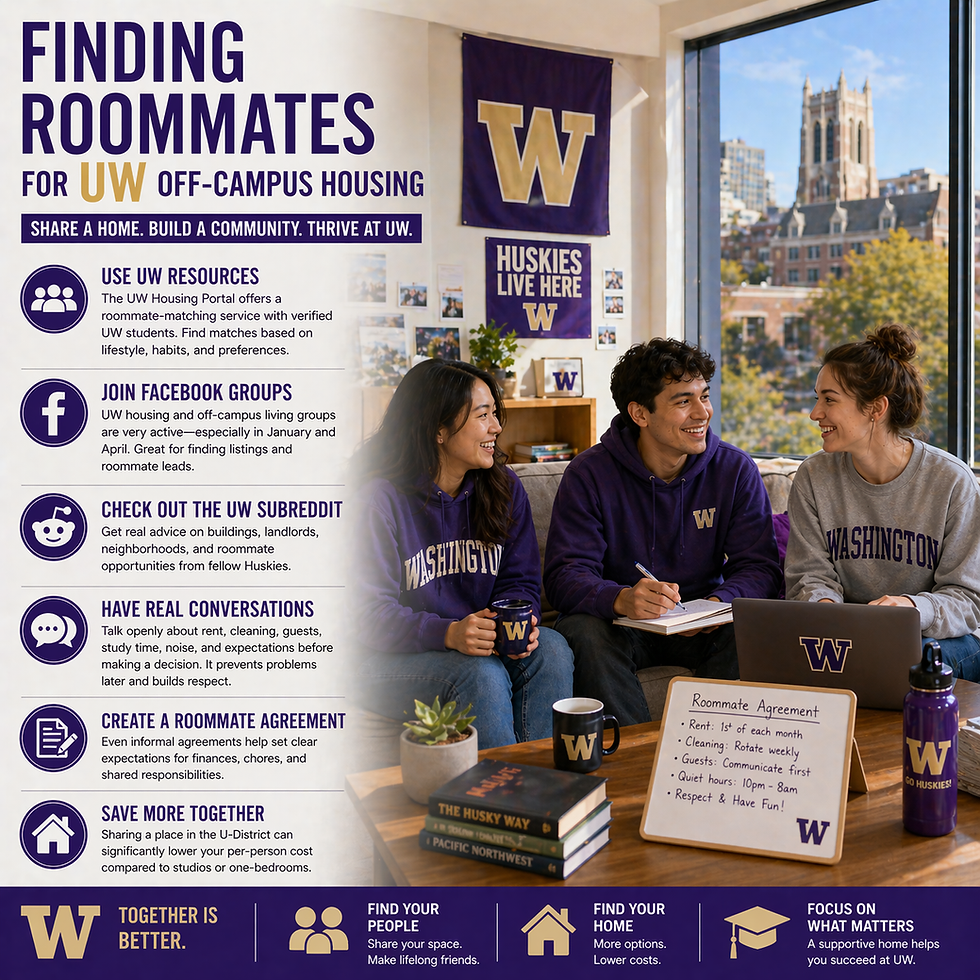
Sharing your university of washington housing with roommates is one of the most effective ways to manage the cost of living in Seattle while also building a community of friends during your time at UW. The University of Washington's official housing portal includes a roommate-matching service that allows students to post profiles and search for compatible matches based on sleep schedules, study habits, cleanliness preferences, and lifestyle factors. Using this official platform provides a degree of accountability that anonymous listings cannot offer, since all users are verified UW affiliates. Facebook groups dedicated to university of washington housing and UW off-campus living are also highly active, particularly in January and April when new academic terms begin and students are planning housing changes. The UW subreddit on Reddit is another valuable forum where students discuss specific buildings, landlords, neighborhoods, and roommate opportunities candidly. When evaluating potential roommates, a direct conversation before committing is essential. Discuss expectations around rent splitting, shared groceries, cleaning duties, guest policies, and noise levels during exam periods. These conversations may feel awkward initially, but addressing them upfront prevents conflicts that can derail your academic focus. Written roommate agreements, even informal ones, are useful tools for documenting shared expectations around finances and household responsibilities. Many student housing listings in the U-District are designed for groups of two to four students and offer significantly lower per-person costs than individual studios or one-bedrooms. Finding the right roommates early in the search process expands your university of washington housing options and makes the entire transition to off-campus living more manageable and enjoyable.
Find off-campus housing near University of Washington: https://uw.offcampus-universe.com/off-campus-housing-near-university-of-washington
This article is provided by an independent housing resource and is not affiliated with, endorsed by, or sponsored by University of Washington.


Comments