.png)

U District Student Housing: A Renter's Guide to Off-Campus Life
- Owen Conrad
- Jul 8
- 6 min read


Seattle's University District has reinvented itself over the past decade. New mid-rises stack along Brooklyn and Roosevelt, Link Light Rail connects you to downtown in minutes, and Ave-side cafes pull in writers, gamers, and engineers all day long. If you're looking for u district student housing, you'll find an unusually wide spread from older walk-ups to brand-new tower studios with skyline views. To start comparing actual listings, you can Find off-campus housing near University of Washington and skip the dead-end Craigslist hunts.
The U District's transformation matters because it changed what's possible at every budget level. A studio in a 2020s tower might cost about the same as an older one-bedroom further out and the trade-offs define your year. This guide walks you through everything that shapes a smart lease.
U District Neighborhood Layout
The Ave (University Way NE) is the spine of the district. East of the Ave, you find quieter blocks of vintage Craftsman houses converted to student rentals. West, toward I-5, the streets are denser with new mid-rises. North of NE 50th, things calm down quickly and you start blending into Roosevelt and Ravenna. South of Campus Parkway, you get closer to the Husky Stadium light rail station which is the single biggest commute upgrade in recent years.
Walk a few blocks west and you reach Wallingford and Fremont, two of Seattle's classic neighborhoods. Roosevelt and Maple Leaf to the north are quieter and family-leaning, with lower rents and the new Link station at Roosevelt opening up a fast commute.
Cost of U District Student Housing
Pricing varies a lot by building age. Studios in newer mid-rises usually run $1,400-$1,900; older converted units start around $1,100 if you're willing to share laundry rooms. One-bedrooms land between $1,700 and $2,500, depending on amenity load. Shared two- and three-bedroom houses bring the per-person rent into the $900-$1,300 range, which is why so many U District students prefer house-shares.
Seattle's renter-friendly rules mean utilities are usually itemized and parking is rarely bundled. Add about $100-$200/month for utilities and another $150-$300 for parking if you have a car. Many U District buildings are explicitly car-free designs, so confirm the parking situation before signing.
Newer studios on the Ave: $1,400-$1,900
Older studios east of the Ave: starting near $1,100
One-bedrooms: $1,700-$2,500
Per-person in a 3-bed shared house: ~$900-$1,300
Commute, Transit, and Living Car-Free
U District has become one of the strongest car-free neighborhoods in Seattle. The Link Light Rail U District Station opened in 2021, putting downtown ten minutes south and SeaTac airport within thirty. The Husky Stadium station handles south-campus housing nicely. Buses cover everything Link doesn't, and the Burke-Gilman Trail makes biking around UW genuinely easy. To see units that match your transit and commute preferences, Find off-campus housing near University of Washington and filter listings by walk score, bike rack access, or distance to a station.
If you do keep a car, look for off-street parking in lease language explicitly. Street parking in much of the U District requires a Restricted Parking Zone permit, which costs around $65 every two years but doesn't guarantee a spot during the school year.
Lease Timing and Common Terms
Lease cycles in the U District lean heavily toward September move-ins. The earliest listings hit market in February and March; by May the best-priced units are typically gone. Older houses convert to roommate-shared leases that sometimes start as early as August 1 or as late as October 1, giving more flexibility. Always confirm whether your lease starts on the 1st of the month or a midstream date, and how prorated rent works.
Seattle's renter protections are stronger than most U.S. cities. Landlords need cause for non-renewal, and security deposit returns are tightly regulated. Read your lease carefully, particularly around early termination, sublet rights, and the building's specific rules on guests and quiet hours.
What to Inspect on Tours
Seattle rain and damp shape what to check. Look for water staining along window sills, mold spots near bathroom ceilings, and the integrity of basement-level units. Test heat in multiple rooms; older houses sometimes rely on baseboard heaters that run up the electric bill fast. Ask about insulation, double-pane windows, and weatherization grants the landlord has done.
On the security side, U District has improved a lot but still varies block to block. Confirm exterior lighting, controlled access, and package locker arrangements. Ask current tenants how responsive the landlord has been to maintenance.
Roommate Selection in the U District
U District housing rewards careful roommate selection. Group houses go fast, and the wrong roommate mix can sour a year quickly. Build your group with people whose schedules and noise tolerance actually match. Agree on rent split, utility split, and a roommate-replacement plan before signing. Most leases here are joint-and-severally liable, meaning each tenant is responsible for the full rent if others stop paying.
U District landlords range from small independent operators to larger property management companies. Ask current tenants which type you're dealing with and adjust your expectations.
Seattle Tenant Protections Worth Knowing
Seattle has some of the strongest tenant protections in the country, and U District renters benefit. Landlords need just-cause for non-renewal, security deposit returns are tightly regulated, and the Seattle Renter Resource Line provides free assistance. Move-in fees and last-month-rent requirements have specific caps and rules.
Renter's insurance is required by most U District buildings and costs $12-$25/month for typical coverage. Don't skip it; Seattle's tree-heavy neighborhoods occasionally see wind-damage incidents.
Settling In: Your First Week
Document everything in your first 72 hours. Photograph every surface, file any maintenance requests immediately, and email a move-in walkthrough to your landlord. Washington gives landlords 21 days to return your deposit after move-out, and clear documentation is your single best defense. Test every system because Seattle's damp climate means appliance issues sometimes surface only after the building is occupied.
Set up your power, internet, and trash account in week one. Some U District buildings include trash and recycling; others bill separately. Confirm your bike storage. Introduce yourself to neighbors; in the U District, they're often the source of the best food, study spot, and life-hack recommendations you'll get all year.
Common Questions About U District Housing
Should you live on the Ave or off it? The Ave has the most energy and walkability but also the most noise. Quieter renters often prefer streets one or two blocks east or west. Both can work; choose based on your tolerance for noise.
How does Seattle weather affect daily routine? Seattle's reputation for rain is overstated, but the gray overcast days from October through April are real. Choose housing with adequate natural light if you're sensitive to seasonal mood shifts. Insulation and HVAC matter too because older buildings can feel damp.
What about graduate housing options? UW has on-campus graduate housing, but many grad students prefer the U District's variety. North of NE 50th, you find quieter blocks favored by grad students. Roosevelt and Ravenna also work well for this audience.
Planning Beyond Year One
U District renters often move multiple times during their UW years. Your first lease typically prioritizes cost and learning the neighborhood. By your second or third, you know which blocks actually fit your routine. Maintain a clean rental history; Seattle's strong tenant protections make landlords cautious, and a documented good record opens doors.
Many UW students relocate to Capitol Hill, Wallingford, or Fremont for upperclassman and grad years. Light Rail expansion continues to open up viable neighborhoods. Network with current tenants in your target area; word-of-mouth often beats public listings.
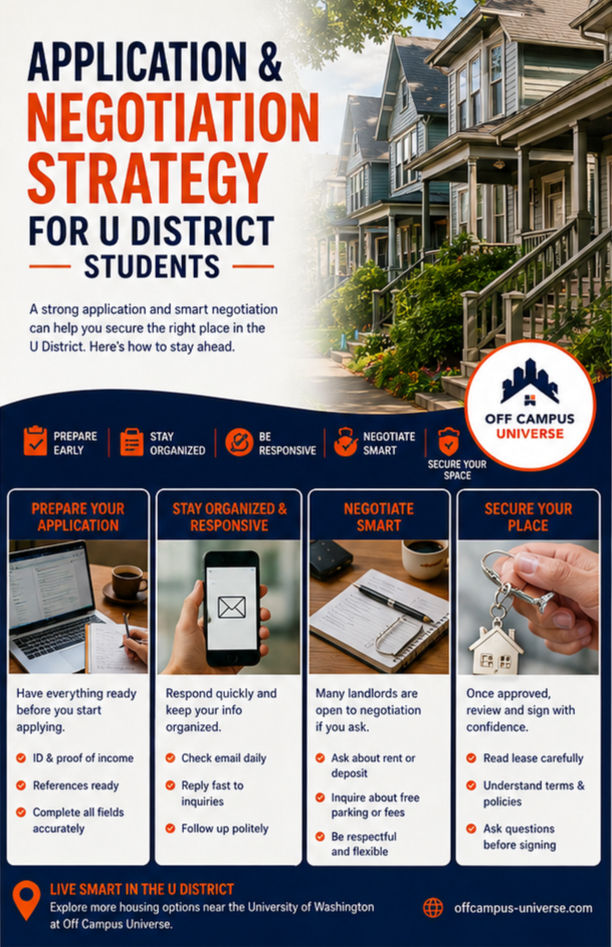
Application and Negotiation Strategy
When you apply for housing near UW, presentation matters as much as price. Have everything ready: government ID, proof of income or a guarantor's signed agreement, a reference from a previous landlord, and a brief cover letter explaining who you are, what you study, and why you'll be a reliable tenant.
Negotiation is more possible than most students realize. Landlords are flexible on application fees, security deposits, free parking, free Wi-Fi, or a small move-in credit. If you have strong credit or willingness to sign a longer lease, mention those as leverage.
Finally, read every clause before signing. Pay specific attention to the early termination clause, the sublet rules, the maintenance response timeline, and the rules around guests, pets, and parking.
Finalizing Your U District Lease
U District housing rewards careful planning because options range widely. Match your budget to the building age and commute that suits you, and tour in person before signing. When you're ready to compare current u district student housing, Find off-campus housing near University of Washington.
This article is provided by an independent housing resource and is not affiliated with, endorsed by, or sponsored by University of Washington.


Comments